
A Digital Dawn over IR through IoT / AI
- Puneet Chawla, CMD/RailTel
Businesses have been looking for ways to improve upon processes with the use of new technology since ages, and this has immensely contributed to progress and wealth creation. In this new world order of innovation in the workplace, if you’re not willing to embrace new technology, you will not be unable to compete, grow and evolve. All through its history of 150 years, Indian Railways has shown a penchant for adoption of robust and latest technology in all its facets of working., Indian Railways is again on a path of reinvigorating itself with a slew of digitalisation initiatives to bring in efficiency, transparency and reducing carbon footprint with slew of measures. The initiative being implemented by RailTel like e-office for which in all 3 Phases has been completed, Electronic Interlocking which has been completed at 4 stations and work is in progress at 8 more stations of Northern Railway, high speed public Wi-Fi at 6070+ stations has been completed with the Wi-Fi now available at 15 stations of Kashmir Valley, CCTV based Surveillance System has been implemented at 290+ stations by RailTel, Hospital Management Information System has also been implemented at 695 Hospitals /Health Units of Indian Railways. Other initiatives by Railway such as Real Time Train Information System (RTIS) for automatic chart preparation and passenger train information, ‘RailMadad’ an integrated complaints platform, modernizing its signaling system by implementing Modern Train Control system with Long Term Evolution (LTE) based Mobile Train Radio Communication (MTRC) System, Human Resource Management System etc are going to bring in efficiency, enhanced safety and passenger’s comfort.
The future of work requires changing tedious, time and revenue consuming, manual jobs, into strategically automated tasks and systems. The Services related to supply chain management and operations, strategy, and customer services is becoming increasingly dependent on AI technologies in order to stay competitive in the marketplace. This is true for Education, Health care, telecom, transportation, consumer retail, financial services, industrial, energy companies, and beyond.
Most organizations agree that AI will enable them to maximize their competitive advantage. However, very few of these organizations have successfully implemented such technologies. Some of the adopted measures are still in the pilot stages, and have not been fully adopted for regular operations. Hence, we can safely say that there is huge scope in businesses whether large, medium or small for roping in existing and emerging technologies to their benefit.
The adoption strategy is just as crucial to the process as the technology itself, because it requires a complete makeover of how processes are managed. A bad deployment strategy is as likely to result in failure as adoption of an unsuitable technology.can result into huge losses The implementation blueprint should take into account the fabric of project management as well as the structure of accountability within the organization.
At it’s core, AI is machine learning, and the intelligent use of data and information. The future of work is impacted by innovations that can be made from such information duly identifying patterns in data trends and carrying out predictive analytics, responding to real-time conditions and building up knowledge base of decisions is something that humans cannot do so quickly.
Any device, connected to the Internet, and capable of sending and receiving data, is part of IoT. Sensors deliver data, but data can only become valuable if it means something important, and is actionable. IoT and AI go hand in hand for determining how to use data in useful ways. IoT can inform AI, and AI brings context and creativity to create informed action. With the help of IoT, “smart machines” simulate intelligent behavior to make informed decisions through Predictive analytics – “What will happen?”,Prescriptive analytics – “What should we do?” and Adaptive/continuous analytics – “What are the appropriate actions or decisions? How should the system adapt to the latest changes?
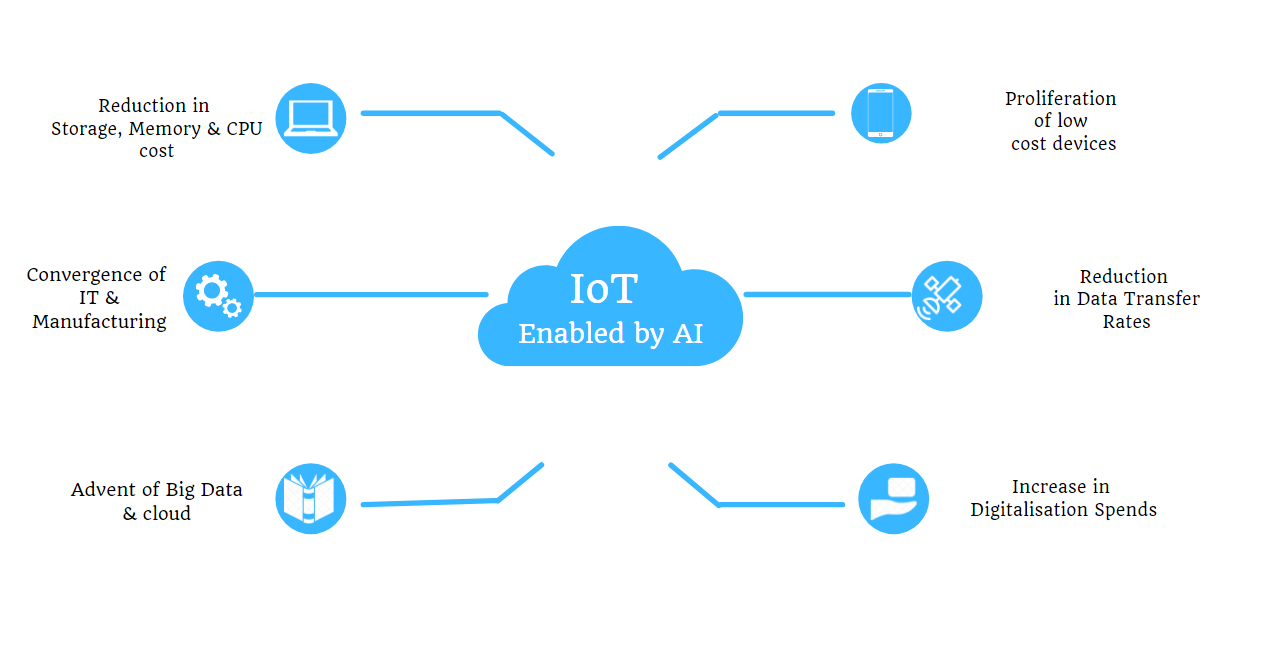
Most AI algorithms need huge amounts of computing data and computing power, relying on powerful servers and central data storage. To be sure that data is processing at an efficient rate, edge computing becomes necessary. Because of the nature of Big Data, many would assume that data obtained on edge devices should be directed back to the central data processing center or a Cloud repository; however, that isn’t realistic. Instead, with edge computing, IoT devices are transferring data to local devices to store and process, and only a portion of that data is sent to the central data repository, or corporate data center.
Manufacturing can utilize connected sensors to monitor and manage the health of manufacturing equipment, which, over time can help identify root causes of defects, its utilisation pattern and improve production, quality and the value of depreciating assets over time.
Manufacturing can utilize connected sensors to monitor and manage the health of manufacturing equipment, which, over time can help identify root causes of defects, its utilisation pattern and improve production, quality and the value of depreciating assets over time.
Security and logistics for edge computing depend on a variety of variables, like what kind of data the edge devices are collecting, and how useful would that data be to hacker, without context or meaning. It is arguable that security for an organization is improved by implementing edge devices, because the less data being shared over a network, the better. If the main Cloud environment is compromised, data from edge devices (or at least some of it) won’t be stored or processed there, thereby keeping that data away from harm.
However, it can also be argued that the edge computing devices themselves can be breached without access to the main data processing center, which, depending on the kind of data being collected, is also a great risk. Security from all access points will continue to be paramount as organizations temper the way they manage their data.
It is doubtful that the Cloud and/or huge data processing centers will go anywhere, and more likely that the Cloud and the Edge will work symbiotically. While the Edge will allow certain functions that require speed and quick processing to redistribute data processing that is latency-sensitive, data centers and the Cloud will still function for mass storage and data processing.
IoT devices generate zillion bytes of data. Cloud computing with its different models and implementation platforms help organizations to manage and analyze the data, enhancing the overall efficiency and working of IoT system. IoT solutions require connection between devices, people and processes. Cloud computing plays a very important role in this collaboration and creates high visibility. Organizations can create applications and software through cloud service, which can connect devices and enable device registration, on-boarding, remote device updates and diagnosis in the least possible time with reduction in the operational and support costs.
Successful implementation of AI & IOT based solutions in the context of India, have the following perquisite of infrastructure requirements.
- 1. A robust high speed OFC based transport network.
- 2. MeitY empanelled cloud
- 3. Edge data centre
- 4. Security Operation Centre
- 5. Skilled Human Resource
- 6. Network of Partners
- 7. High Speed communication network
RailTel already has a robust high speed, high capacity OFC network covering 60000+ RKm, city wide access network of 18000 KM, 2 UPTIME certified Tier-III Data Centres at Gurugram & Secunderabad with MeitY empanelled RailCloud, edge data centres at 5 Metros viz HYB, SBC, MAS, Mumbai & Chennai, State of the Art Security Operation Centre to take care of all cyber security threats, inhouse availability of skilled and technically qualified manpower and network of 240 digital service partner/business associates who can deliver niche solutions for all technical problems. On the back of such infrastructure and skill set RailTel is in a position to deliver on the AI/IOT based requirements of the Railways. Indian Railway is in the process of setting up a High Speed communication network on LTE technology.
Indian Railways has a large inventory of stationary and moving assets for which Railways follow periodic maintenance philosophy. On some of these assets sensors are now provided to monitor critical parameters. The data from these sensors through the use of RailTel’s OFC network is to be brought to RailTel’s cloud where comprehensive analysis of data can be made using data analytics. Feedback on the assets likely to fail can be sent to the concerned maintenance team, thereby shifting to predictive maintenance philosophy /condition-based monitoring for improving asset maintenance and reliability. Similarly efforts are on to automate activities like train examination, rolling in /out examination through use of machine vision, wheel profile measuring equipment, hot box detectors, acoustic bearing monitors to monitor the condition of moving assets, analyse the data at local servers to identify patterns and insights that would be impossible for a humans to accomplish for optimizing the operations quickly and efficiently by knowing what needs attention. This will minimize subjectivity, reduce down time, improve operations and reduce high manpower cost and at the same time enhance safety. RailTel has already implemented industry 4.0 solutions on Proof of Concept basis in manufacturing and maintenance set-ups. At Rail Wheel Factory the existing CNC Machine was connected to i-Lens IoT Edge device using existing Ethernet port. The IoT device was programmed to fetch the data from PLC. The Machine parameters were configured to view necessary trends and reporting structure. The Alerts based on received data was configured and provided to the factory team.
RailTel also did a pilot e-Train Signal Register implementation where automatic, accurate updating of Train movement data in real time from Data Loggers was done. The train movement data is directly captured by the Control Office Application thereby providing accurate and reliable train information. This also reduces stress on Station Master. At a workshop, Energy Management solution was implemented where the data from Energy Meters was collected through an IOT based system to carry out online monitoring of Energy consumption through a dashboard and provide trend analysis and demand forecasting.
RailTel, has deployed IoT Based Condition Monitoring and Predictive Maintenance system for Signalling assets as POC at Malkajgiri Railway station of South Central Railway. The field sensors have been provided for various signalling gears like Signal, Point Machine, Track Circuit, Internal and External power supply and battery system. Data from the IoT devices are transmitted wirelessly to Local Workstation kept where edge computing is done along with Data Logger output. The first level fault information/remote diagnostics are done in the edge computing system. The edge system is further connected to RailTel Cloud through RailTel’s backbone for Data Analytics and reporting.
RailTel further implemented an Artificial intelligence (AI) and web-based Attendance system in 46367 schools in 33 districts of Assam for 48 lacs users including students, teachers and non-teaching staff. The learning from this implementation can be applied to execute similar projects for workshops and offices of IR to bring about transparency and effectiveness in management of attendance.
RailTel is also implementing Hospital Management Information System which is capable of providing predictive analysis and dynamic stock requirement of various medicines based on consumption pattern. The software, based upon the various diseases being reported by the various patients, can carry out predictive analysis and indicate if there is a possibility of an epidemic outbreak or a spurt of some disease in a particular area. The system has provision for connecting the various medical devices available in the particular hospital and capturing the output of the devices automatically without human intervention.
IR has also installed Water Level Measuring Instrument using Pulse RADAR on important bridges to monitor water level at bridges and send alert in case of danger and predefined levels being breached. Similarly Continuous Rail Temperature (CRT) monitor is used by Indian Railways to measure/monitor rail temperature and are installed at some pilot locations on Indian Railways. RailTel is implementing a software solution for obtaining data inputs from these IOT devices and transport the data generated through its OFC network to RailCloud and populate it on the Track Management System and Bridge Management System Applications. The system is being designed to take inputs from upto 50,000 IoT field devices. The server can simultaneously receive data from all the locations and Data analytics will be performed. The alerts and daily reports will be generated to provide meaningful insight for actionable output to reduce failures.
An Indian Railway Civil Engineering Telemetry application platform is also being developed to access this data. IR has recorded/ is recording drone footage of all of its track. These are stored in local servers. A program for viewing of these feedbacks through Telemetry application Platform is to be developed for users over Zonal Railways, Divisions and Sub-Division/Section.
IR has presently installed/is installing CCTV cameras at various project sites. A software is being developed, to access the real time live feed of these cameras through Telemetry application Platform so that a user who is provided with the access password for a particular site, can access the real time live feed of these cameras.
There is immense potential and benefits that can be achieved through use of IoT/ AI and connected system and we are slowly beginning to realize the benefits of these small yet momentous steps that we are taking to create a new and better way of delivering products and services. RailTel is very keen to be a part of this journey and will be contributing in a big way in the digital transformation of the lifeline of the country.